
Quick Summary on HR Outsourcing
HR outsourcing helps employers manage a complex workforce. Businesses can outsource specific tasks like payroll, or get full HR support. As organizations expand, DIY HR gets tougher to manage. DIY can raise risks, lower efficiency, and lead to missed strategic changes. The right HR outsourcing approach can help employers:
-
Reduce administrative burden and compliance risk
-
Access specialized HR expertise and modern technology
-
Scale HR operations as headcount, geography, and complexity increase
-
Improve consistency in employee experience and HR processes
-
Gain economy-of-scale pricing and service benefits
Many growing or multi-state employers find value in partnering with a PEO. It offers a single-source HR outsourcing solution that supports compliance, benefits, and long-term workforce strategy. Leaders can keep control and focus on growth, too.
When the Business Grows Faster than HR
As a business grows, the HR functions also expands. It becomes larger, more complex, and more important. What begins as payroll and basic hiring paperwork quickly grows into:
-
Benefits administration
- Compliance tracking
- Employee relations
- Technology management
- Risk mitigation
In fact, all too often, the demands of HR will outpace internal staffing capacity. This can happen much faster than many business leaders and owners realize. By the time you've hit even just a handful of workers, the time and expertise needed to manage HR tasks will be increasing exponentially. For many employers, meeting these demands can be very tough. That's especially true for those with small HR teams.
Enter Human Resources outsourcing (HRO) as a practical and strategic solution.
But how does HR outsourcing work? When is it time to outsource? What benefits can you expect from it?
This guide provides a straightforward look at Human Resources outsourcing. It covers various models, HR services you can outsource, and tips to choose the best approach. The goal is to help employers see how HR outsourcing works. It's not a one-size-fits-all solutions, but rather a key part of modern workforce management.
What is HR Outsourcing (HRO)?
At its core, HR outsourcing means handing over some or all HR tasks to an outside company. These responsibilities can include tasks like payroll processing. They might also cover more HR services like:
-
Compliance management
- Benefits administration
- Onboarding new employees
- And more
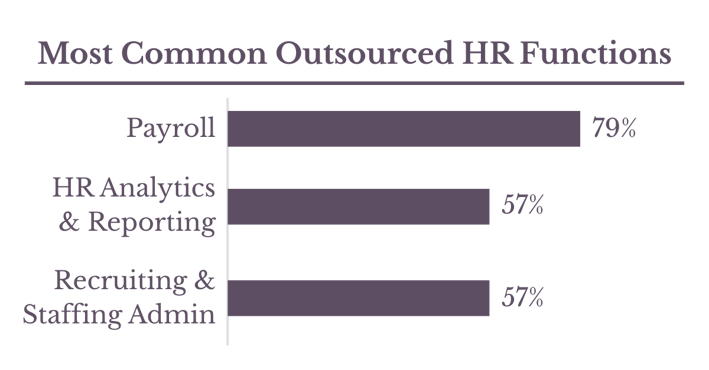
HR outsourcing is quite common. Nearly two-thirds (63%) of organizations outsource at least one HR function. Importantly, Human Resources outsourcing does not always mean handing over the entire HR function. Many employers start by outsourcing individual tasks. Payroll, for example, is by far the single most commonly outsourced HR function by a wide margin. Per Deloitte, 79% of organizations that outsource any HR function outsource payroll specifically.
The Different Types of HR Outsourcing
One of the most common misconceptions about HR outsourcing is that it follows a single model. Employers have many options.
Each approach offers different levels of service, technology, and support. Understanding these options is key when looking at HRO choices. Different models have their own strengths and weaknesses, so they may not suit every situation or need.
Professional Employer Organization in HR (PEO)
A Professional Employer Organization, or PEO, represents one of the most comprehensive forms of HR outsourcing. In this model, the employer forms a co-employment relationship with the PEO. This means both the PEO and the business client share responsibilities.
The PEO will manage tasks such as:
- Paying wages and taxes under its EIN
- Offering workers' comp and risk management services
- Providing help with employment-related rules and regulations
Meanwhile, the business maintains control over day-to-day operations and employee management.
The ultimate goal of a PEO is to “help business owners and executives save time by taking administrative and HR-related tasks off their plates, allowing them to focus on the success of their businesses,” says NAPEO. That’s why a 2024 NAPEO analysis showed that PEO clients grow more than 2x faster than businesses that don’t use PEOs.
PEOs work best for small to midsize employers, fast-growing companies, and multi-state businesses. They offer scalable HR support without needing big internal teams.
.png?width=1200&height=250&name=Website%20Banner%201200%20x%20200%20(16).png)
HRO
Employers can also opt to outsource HR functions without a co-employment model. The employer takes on all HR-related risks alone. This way, it loses the shared liability of co-employment.
However, this approach lets organizations tackle issues step by step. They can also create an outsourcing solution that fits their specific needs. You might outsource tasks like payroll processing, HR analytics, reporting, benefits administration, or recruitment support. However, you can still manage other HR duties in-house.
HRIS
HRIS platforms, or Human Resource Information Systems, are software tools. They manage employee data, payroll, benefits, and reporting. While HRIS platforms support HR efficiency, they are not full HR outsourcing solutions. Instead, they are third-party tools that support and ease in-house handling of HR tasks.
Nearly 80% of organizations use HR software in some capacity. However, compared to service-based human resource outsourcing, HRIS platforms typically offer limited compliance guidance and minimal hands-on support.
SaaS HR Outsourcing
SaaS HR platforms are like HRIS but use cloud technology and offer different levels of automation and self-service options. Some solutions offer optional managed services with the software. This creates a hybrid type of HR outsourcing.
This model is great for employers who want efficiency and standardization. It's ideal for those who don't need extensive strategic support. The tradeoff is that SaaS platforms depend a lot on employers managing themselves. This can limit how effective they are as a standalone HR outsourcing solutions.
HR Self-Service SaaS Works When:
-
The organization has in-house HR expertise and primarily needs technology to streamline workflows.
-
HR tasks are predictable and standardized, with limited need for customization or advisory support.
-
HR is viewed mainly as an administrative function, not a strategic driver.
Managed SaaS HR Outsourcing Works When:
-
The employer wants technology plus hands-on HR support, not software alone.
-
Internal HR bandwidth is limited or overstretched, even if HR expertise exists.
-
The employer values having a single (human) point of contact for both HR services and technology.
BPO
Business Process Outsourcing, or BPO, focuses on narrowly defined, transactional HR activities. In HR contexts, BPO may include call center support, data entry, or payroll processing.
This works for businesses needing admin support and compliance advice to ease their workload. However, BPO solutions provide only basic strategic and compliance support. They mainly have an administrative role. Their services focus on tasks, not advice or growth. As a result, BPO represents one of the more restricted forms of HR outsourcing.
What HR Functions Can Be Outsourced?
One of the strengths of Human Resources outsourcing is its flexibility across functions. Employers can outsource many HR services. This choice depends on your needs and what they can handle internally. Commonly outsourced HR services include:
-
Payroll processing, including tax filing and wage reporting
-
Benefits administration, such as enrollment, carrier coordination, and renewals
-
Compliance and risk management, including labor law guidance and reporting
-
HR administration, such as employee records and policy management
-
Employee onboarding and offboarding, ensuring consistent processes
-
HR technology and reporting, including analytics and workforce insights
-
Recruitment and staffing, from job postings to candidate screening
Benefits of Outsourcing HR
Employers can and should connect human resources outsourcing to tangible business outcomes. Fortunately, HRO can be an enormous value-driver for organizations that use it well.
By outsourcing technology, administration, and advisory services, companies can boost HR performance. This, in turn, helps to directly strengthen business performance. It can help organizations run more efficiently. It reduces the administrative burden and cuts down on errors. This happens by moving time-consuming tasks away from internal teams.
Outsourcing can also be a tremendous risk mitigator. Employment laws evolve constantly. HR outsourcing providers often keep a closer eye on these updates more than internal teams do, since those teams have other priorities.
When Should You Outsource HR?
No single trigger point exists for HR outsourcing, but some signs can signal it's time to think about it.
- Rapid growth often increases HR complexity faster than internal teams can adapt.
- Multi-state expansion introduces new compliance requirements.
- Limited internal HR resources can lead to reactive decisions instead of proactive workforce planning.
.png?width=1200&height=250&name=Website%20Banner%201200%20x%20200%20(17).png)
In-House HR vs Outsourced HR
Internal HR teams provide close support and valuable knowledge. However, they need continuous investment in staff, training, and technology. Outsourced HR models offer wider expertise and better compliance. Plus, they come at a fixed cost.
DIY HR usually works best for two groups.
- Very small businesses with simple needs that one or two people can handle
- Very large companies that can afford big HR teams
Key risks of DIY HR include:
- Cumulative compliance liability from wage and hour errors, misclassification, leave mismanagement, and poor documentation
- False cost savings, including higher payroll costs, legal exposure, and lost leadership time
- Talent and brand risk can rise from
- Inconsistent onboarding
- Weak employee experience
- Higher turnover
Single-Source vs Multi-Source HR Outsourcing
With a multi-source approach, employers use multiple partners to provide HR services. This piecemeal strategy can offer flexibility and help control costs in the short term. It's great for businesses building their HR capacity step by step. Managing multiple vendors adds complexity, leads to inconsistency, and can split HR operations. No single provider has full accountability for HR tasks. This is because responsibilities are divided among different providers.
A single-source approach combines multiple HR services under one provider, like a PEO. This model makes vendor management easier. It also ensures consistent service delivery. Plus, it can save costs by leveraging scale.
A single partner can also provide more integrated support across HR activities. The tradeoff is that you depend more on one vendor. So it's key to manage that relationship well and know the contract terms before you commit.
How HR Outsourcing with a PEO Supports Business Growth
If growth is your goal, PEOs like CoAdvantage is a great choice for HR outsourcing. PEOs are purpose-built to help growing businesses succeed. By combining HR services, benefits access, compliance expertise, and technology infrastructure, you can manage workforce complexity without replacing internal leadership. The result is a wide range of better business outcomes.
-
PEOs help businesses better attract better workers.
-
PEOs help to protect employers by strengthening compliance.
-
PEOs enable businesses to save both time and money.
-
PEOs put small businesses on par with enterprises.
.png?width=776&height=162&name=Website%20Banner%201200%20x%20200%20(15).png)
FAQs on HR Outsourcing
What does HRO mean?
HRO also means HR outsourcing. It involves hiring an outside provider to handle HR services or functions.
Do I lose control by outsourcing HR?
No. HRO providers support HR operations, but employers retain control over business decisions and employee management.
What HR functions are outsourced the most?
Payroll, benefits administration, and compliance support are among the most commonly outsourced HR services.
What HR functions should not be outsourced?
Strategic leadership decisions, culture development, and final hiring authority typically remain in-house even with HR outsourcing.
Should I outsource HR if I already have an HR department?
Many organizations use Human Resources outsourcing to supplement internal HR teams, particularly for compliance and administrative support.
Should I single-source or multi-source HR outsourcing?
The right approach depends on complexity and internal capacity. Single-source HR outsourcing often simplifies management, while multi-source models offer specialization.
What factors can affect success in outsourcing HR?
Clear goals, strong communication, and selecting the right HRO model are critical to long-term success.