
Quick Summary
A Professional Employer Organization (PEO) supports small and mid-sized businesses with comprehensive HR services. PEOs use a co-employment partnership, combining HR expertise, technology, and scale.
-
Handles payroll, benefits, compliance, and HR administration
-
Gives access to enterprise-level benefits and HR support
-
Reduces costs, risk, and administrative burden
-
Improves employee experience, retention, and payroll accuracy
-
Frees leadership to focus on growth, strategy, and people
Rather than replacing leadership, a PEO supports it. An integrated HR model with ongoing support helps businesses gain stability and flexibility. This approach turns HR from a limitation into a driver of sustainable growth, giving companies a competitive edge.
You Can't Make More Time, But You Can Choose More Life
Your roadmap to more life outside of work starts with smoother HR.
Time is the most valuable resource a business owner has. Once it's gone, you can't get it back. HR tasks can quickly fill your day. Payroll deadlines, compliance issues, hiring needs, and employee questions all add up.
You can't make more time.
But you can choose more life.
For many small and mid-sized businesses, that choice starts with partnering with a Professional Employer Organization (PEO). A PEO helps make HR easier. It reduces admin burden, and give business owners back more time and clarity to lead and grow.
What Is a PEO? (What Does PEO Stand For)
A Professional Employer Organization (PEO) provides comprehensive HR outsourcing services through a co-employment relationship.
In a PEO partnership:
- You retain control over your business operations, culture, and employees' daily work.
- The PEO shares employer responsibilities such as payroll processing, tax filing, benefits administration, and compliance support.
The key point: a PEO does not replace your leadership. It strengthens it by taking HR complexity off your plate.
Who PEOs Typically Serve
Professional Employer Organizations are often used by small to mid-sized businesses. These businesses are growing quickly and need more HR support than they have on their own. According to the National Association of PEOs (NAPEO), half of PEO clients have between 10 and 49 employees and over a third (35%) have fewer than 10.
These employers face increasing complexity around payroll, benefits, and compliance, and risk management if they add even just a few new workers. PEOs are especially valuable for such organizations that lack dedicated HR expertise but still need enterprise-level support, as well as for growing companies that want to stay focused on core operations without being pulled into the day-to-day demands of HR administration.
How PEOs Work for Small and Mid-Sized Businesses
Small and mid-sized businesses face a unique set of HR challenges. They’re big enough to handle payroll, benefits, and compliance needs. But they're often not large enough to staff full HR teams or negotiate big benefits on their own. As a result, owners and leaders often find themselves pulled into HR administration at the expense of growth-focused work.
This is where PEOs are purpose-built to help. SMBs can shift routine employment tasks to a co-employment model. This way, they access skilled HR professionals. These experts help with hiring, managing employees, and ensuring compliance. That guidance helps reduce costly missteps while giving leaders confidence that they're handling HR the right way.
The cumulative effect is leverage. Time, attention, and resources are freed up and reinvested back into the business itself. Leaders focus more on revenue, strategy, and innovation. They rely on a strong HR infrastructure and a stable workforce for support. For SMBs navigating growth with limited internal capacity, a PEO turns HR from a constraint into a competitive advantage.
How Does a PEO Work?
Co-Employment Relationship
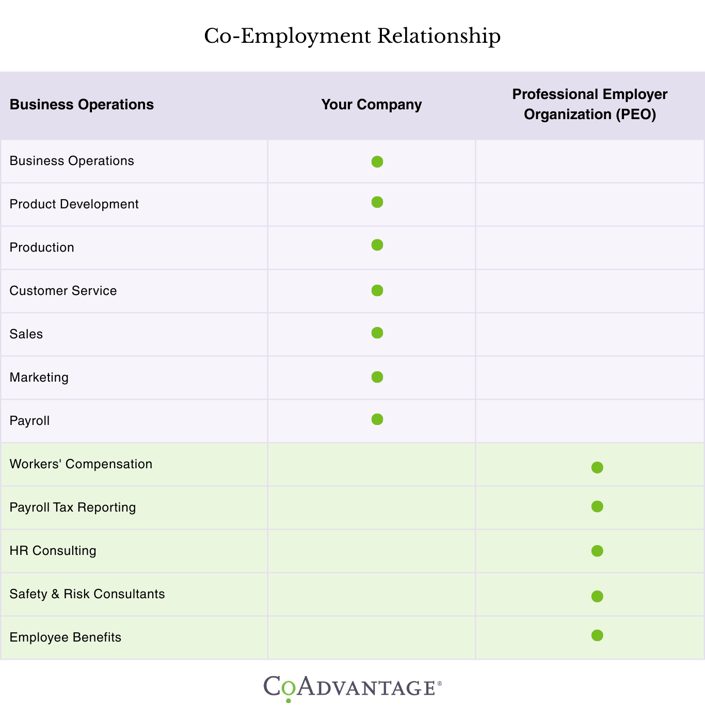
A PEO arrangement centers on a co-employment relationship. This setup clearly divides responsibilities between the employer and the PEO. The businesses retains full control over its workforce and day-to-day operations. The business retains control over:
- Hiring and firing
- Setting pay
- Managing schedules
- Directing work
- Shaping company culture
In other words, the employees still report to the business, not the PEO.
The PEO takes on many administrative and compliance tasks related to employment. This typically includes:
- Payroll processing
- Tax filings
- Benefits administration
- Workers' compensation coverage
- Guidance on employment laws and HR best practices
- And more
Shifting these functions to a PEO helps employers to lower administrative tasks and compliance risks. They still keep full control over their business operations and how they manage their staff.
Explore a PEO partnership with CoAdvantage
PEO Services From Start to Finish: A Smoother HR Journey
Think of HR as a roadmap. From hiring your first employee to managing a larger team, each phase adds new duties and challenges. Without the right support, those turns can slow you down. With a PEO like CoAdvantage, you don't navigate that journey alone. You have a partner providing support at every turn.
A PEO model stands out because of its integrated system. It's not just about the services offered; it's how they work together. Recruiting feeds onboarding. Onboarding connects to payroll and benefits. Benefits, training, and compliance reinforce retention and performance. A PEO offers continuous, coordinated support instead of just separate tools or one-time fixes. This support adapts as your business grows.
Recruiting and Onboarding
Hiring the right people should be intentional and smooth. It shouldn't feel random or overwhelming. A PEO makes recruiting and onboarding easier. New hires get support from day one. This way, there are no administrative delays or too much paperwork. In turn, improved onboarding boosts retention. Businesses with structured onboarding see employees that are 58% more likely to remain for three years. Given that turnover can cost as much as 33% of an employee’s annual salary, that saves money as well as workers.
PEOs help by supporting recruiting and onboarding with practical tools and expertise. That may include access to job posting sites, applicant tracking systems, and performance management software. Small businesses often find it hard to deploy, use, and manage all these tools on their own.
The result is a more consistent hiring process. Candidates have better experiences, and transitions from offer letter to active employee are smoother.
Payroll and Timekeeping
Payroll is a key HR function. Small mistakes here can quickly lead to big issues. A PEO handles payroll from start to finish. This includes calculating wages, withholding taxes, filing, and ensuring regulatory compliance. In turn, the PEO reduces the risk of errors that can lead to penalties, employee dissatisfaction, or legal exposure. The PEO also removes a recurring administrative drain on business owners and managers who are already juggling multiple responsibilities.
There is a financial upside as well. Organizations that outsource payroll typically save around 18% on payroll-related costs. Payroll is a great example of why outsourcing is effective. Accuracy improves, compliance risk goes down, and leaders regain time. They can then focus on growing the business instead of processing paychecks.
Benefits Administration
Offering good benefits is a big challenge for small and mid-sized employers. Rising costs and administrative complexity often limit what businesses can provide. That's true even when benefits are critical for attracting and retaining talent.
PEOs help small businesses compete by providing them with top-notch benefits. They do this by pooling purchasing power. This can include big group health plans, retirement options, employee assistance programs, and other perks usually seen with larger employers. Because the PEO can negotiate these plans at scale, PEO users gain access to broader offerings at lower costs.
Administration is equally important. A PEO supports enrollment, compliance, and employee education. It guides workers in understanding and using their benefits well. Employers that work with PEOs are significantly more likely to prioritize helping employees make informed benefits decisions, which directly affects satisfaction and retention.
Risk Management and Compliance
Employment compliance is not a one-time task. Laws and regulations keep changing at all levels: federal, state, and local. So, staying compliant needs constant attention. This is especially challenging for small businesses that lack dedicated compliance expertise.
PEOs help manage risks by keeping an eye on regulatory changes. They also handle workers' compensation and give advice before problems get worse.
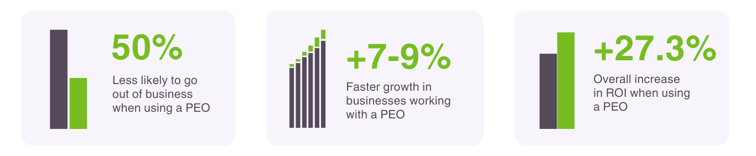
According to National Association of Professional Employer Organizations, companies that work with a PEO are 50% less likely to fail when compared to non-PEO users. That's partly because compliance risks are addressed early rather than reactively.
The financial stakes are high. U.S. businesses spend an average of $10,000 per employee each year on compliance-related activities. Such costs hit small employers especially hard. A PEO helps reduce fines, claims, and surprises by managing workers' compensation, unemployment insurance, and labor law compliance.
Employee Training and Development
Training and development often take a back seat in small businesses. This isn't due to a lack of belief in their value. Instead, it's mainly because of time and resource limits. Yet even modest investments in training can have measurable returns.
“A 10 percent increase in training produced a 3 percent increase in productivity over two years,” said Iva Klepic, the Head of HR at the University of Mostar in Bosnia and Herzegovina, told the Society for Human Resource Management (SHRM).
PEOs make training easier. They offer or coordinate development programs that can be hard to manage otherwise. This may include online learning libraries, compliance training, leadership development, or role-specific education. PEOs often link businesses to trusted third-party providers when training isn't offered directly.
The outcome is a more capable, adaptable workforce that grows alongside the business. Over time, this investment leads to higher performance, stronger engagement, and better readiness for change.
Ongoing HR Support and Expertise
HR challenges don’t arrive on a schedule. Employee relations issues, policy questions, and compliance concerns can surface at any time. With a PEO, employers get regular help from skilled HR pros. They know the business well and offer guidance whenever needed.
This continuous support helps shift HR from a reactive function to a strategic one. Businesses can make better choices about policies, structure, and employee engagement. This helps them avoid scrambling to fix problems later. When HR practices match business goals, HR drives value instead of just being a cost center.
Why Businesses Use a Professional Employer Organization?
Most employers choose to work with a PEO to simplify what it means to be an employer. They want to reduce friction and regain focus. As businesses grow, HR doesn't just get bigger. It gets more complex, more regulated, and more time-consuming. A PEO takes on that complexity. This frees leaders and employees to focus on meaningful work.
Simplification of HR
A PEO combines payroll, benefits, compliance, and HR admin into one source. For employers, this means fewer vendors and handoffs. There are also fewer chances for things to slip through the cracks. Plus, there's a single point of contact for all HR issues.
Time Gains
Business owners and leaders often get stuck in HR tasks because no one else can handle them. Payroll deadlines, benefits questions, compliance updates, and employee issues take up time. That time should be spent on strategy, customers, and growth. Leaders can regain valuable time by offloading administrative tasks to a PEO, without losing visibility or control.
Access to HR Expertise
A PEO gives employers access to seasoned HR experts. They help navigate decisions and changing labor laws before issues come up, not after. That proactive support reduces risk and builds confidence at every stage of growth.
Reduced Administrative Burden
Businesses can use pooled buying power to access great benefits. This helps them attract and keep talent. Payroll processing, tax management, and compliance become easier and more reliable.
Business that partner with a PEO are:
The Employer Benefits of Partnering with a PEO
Reduced HR Costs
Outsourcing almost always comes down to cost reduction, and more often than not, it works. Deloitte’s 2023 Global Outsourcing survey found that 83% of organizations aimed to reduce costs through outsourcing in 2021. Within the next two years, 84% had achieved that goal.
For PEOs specifically, research from NAPEO shows that businesses using a PEO can save up to $1,775 per employee per year. Those savings come from reducing HR inefficiencies, minimizing compliance risks, and streamlining payroll and benefits administration.
The key here is quality of HR service. Advisory firm The Hackett Group has studied the difference between world-class and average HR organizations and found that world-class (high quality) HR teams simply blow past others by every measure. For instance, world-class HR teams operate “at a 34% lower operating cost per employee than peers.”
Small to midsize firms can access top-tier, world-class HR services through a PEO like CoAdvantage. This helps them achieve cost efficiencies for themselves.
Consolidated Labor-Related Expenses
A PEO makes budgeting easier. It combines various labor costs into one clear line item. Payroll processing, benefits administration, workers' compensation, and HR support are handled together. This approach avoids dealing with multiple vendors.
This improves cost visibility, reduces surprise expenses, and makes workforce planning more predictable as the business grows.
Improved Employee Retention
Stronger HR infrastructure directly affects retention. Companies working with a PEO experience 12% lower employee turnover thanks to better onboarding, stronger benefits, and improved HR support. Similar research has shown turnover rates 10 to 14 points lower for PEO users compared to non-PEO employers. Lower turnover reduces recruiting costs, protects institutional knowledge, and stabilizes teams through growth.
Access to Better Benefits
PEOs help small and mid-sized businesses offer competitive benefits by leveraging collective buying power. PEOs pool employees from various client companies. This lets them access large group health insurance plans at better rates. In turn, employers can offer comprehensive benefits without taking on the administrative burden of managing them alone.
Lower Risk and Fewer Compliance Issues
Businesses that partner with a PEO are much less likely to face compliance penalties, audits, or deal with legal issues related to employment. Ongoing regulatory monitoring and expert guidance lower risk. PEOs help employers stay ahead of changing requirements.
.png?width=663&height=347&name=Copy%20of%20CoAd_Case%20Study%20Quote%20Card%202%20(1).png)
Supporting Growth and Competitive Strength
By professionalizing HR, small businesses gain many of the competitive advantages typically reserved for larger organizations. They operate more efficiently, attract top talent, and focus leadership attention where it matters most.
Imagine a small shop with 40 employees trying to keep up with a giant corporation that has 400 or even 4,000 employees. In terms of HR, a PEO puts them on an even playing field. When a small business professionalizes its HR function by partnering with a PEO, it becomes more competitive.
See how CoAdvantage can support your business
The Employee Benefits of a PEO
Better and More Competitive Benefits
One of the most visible employee advantages of a PEO partnership is access to stronger benefits. PEOs help small and mid-sized businesses by using pooled purchasing power. This lets them offer benefits similar to those of larger employers like:
-
Comprehensive health insurance options
- Retirement plans
- Supplemental benefits
- Voluntary benefits and perks
- Employee assistance programs (EAPs)
In other words, through a PEO, small businesses can offer benefits that would otherwise be difficult or costly to provide.
For employees, better benefits are more than a perk. They are a signal of stability and long-term investment. Competitive benefits lower financial stress and boost well-being. They also strongly affect an employee's decision to stay with their employer rather than look for other options.
Enhanced Employee Experience
Many believe outsourcing HR makes the employee experience colder or more distant. In practice, the opposite is often true. PEOs often offer better service, clearer processes, and more consistent communication than small businesses can handle alone.
HR Support and Access to Resources
PEOs also expand employees’ access to HR expertise and self-service resources. Employees can get quick answers to benefits questions, policy concerns, or workplace issues. This way, they don't have to rely on one overloaded HR generalist or business owner.
“Employees no longer need to turn to overworked HR departments to get a comprehensive understanding of what they’re signing up for,” Gary Stevens, front-end developer and founder of Hosting Canada, told Business.com about his experience with a PEO. “Instead, any questions employees may have can be turned directly to the PEO. Since one of their main functions is finding the best plans available, employees no longer need to worry that they’re making a mistake during their yearly enrollment.”
Payroll Accuracy and Reliability
Payroll issues quickly erode trust. In fact, over half (53%) say that repeated mistakes with payroll would lead them to start job hunting. Late or incorrect paychecks create frustration and anxiety, even when mistakes are unintentional. PEOs help ensure payroll is processed accurately and on time, with proper tax withholding and compliance built in.
Reliable payroll may seem basic, but it plays a foundational role in employee satisfaction. When employees trust that they will be paid correctly and consistently, it removes a major source of stress and allows them to focus on their work.
Taken together, these benefits create a noticeably better employee experience. PEOs improve benefits access, service quality, HR support, and payroll reliability. This helps create workplaces where employees feel valued, supported, and more likely to stay long-term.
Spend less time on HR. Choose more life with CoAdvantage.
How a PEO Compares to Other Models
When businesses look into HR outsourcing, a PEO is often only one option they consider. Administrative Services Organizations (ASOs), Employers of Record (EORs), and traditional HR outsourcing models each tackle HR challenges. However, they vary greatly in structure, responsibility, and how well they fit long-term. Understanding these differences helps employers choose the right model for their goals.
PEO vs ASO
A PEO and an ASO may appear similar on the surface, but the underlying relationship is very different. A PEO operates under a co-employment model. That means certain employer responsibilities, such as payroll tax administration and workers’ compensation, are shared. Co-employment helps the PEO provide better compliance support, wider access to benefits, and more connected HR services.
An ASO, by contrast, provides administrative support only. The business remains the sole employer of record and retains full legal responsibility for compliance, taxes, and risk. ASOs help companies that need software and basic admin support. This works well for those with strong HR skills already. For businesses wanting to reduce the risk and get ongoing help, a PEO usually provides better support.
PEO vs EOR
An Employer of Record (EOR) helps businesses hire employees in places where they lack a legal entity, often overseas. In an EOR setup, the EOR is the legal employer. They manage all employment compliance. Meanwhile, this business oversees daily work.
PEOs are designed for ongoing operations within a company's current legal structure, usually in the United States. Employees stay with the business, and the employer keeps control over workforce choices. EORs are great for quick global expansion or short-term market entry. In contrast, PEOs are better for long-term growth, stable workforces, and integrated HR management.
PEO vs Traditional HR Outsourcing
Traditional HR outsourcing often includes specific services like payroll processing or benefits administration. These are usually provided by different vendors. These arrangements often lack integration and strategic support, and employers must coordinate multiple providers.
A PEO brings together these functions into one coordinated model. It combines technology, expertise, and accountability. Instead of handling HR in pieces, businesses build a lasting partnership that grows with their needs.
How to Know When It's Time to Outsource HR
Outsourcing HR to a PEO isn’t about hitting a specific employee count. It’s about readiness. As businesses grow and evolve, HR demands often increase faster than internal capacity. Here are some signs that show a PEO partnership could bring real value to your organization.
Your Business Has Reached the "Sweet Spot" Size
Most businesses get the most benefits from a PEO when they are big enough to feel HR pressure, but not big enough to need a full internal HR team. That's why so many small businesses start turning to PEOS, even with only a dozen or so workers. That said, the key factor isn't headcount alone. It's when payroll, benefits, and compliance needs go beyond what your team can handle. Leadership focus also falls short.
You Lack In-House HR Capacity
In many growing businesses, HR tasks often land on owners, finance leaders, or busy managers. Over time, this leads to a tough choice: either HR work suffers or revenue-generating work does.
Even organizations with HR staff can reach this breaking point. Nearly three-quarters of HR professionals feel overstretched. They cite limited time and staffing as major barriers to success. When capacity gaps start affecting performance, outsourcing becomes a practical solution.
Your HR Operation Isn't Scalable
Would you current HR operation hold up if your employee count stayed the same but complexity grew? New rules, multi-state payroll, remote work, and complex benefits can stress systems that used to work well. If HR processes don't scale with complexity, risk, and inefficiency tend to follow.
You're Struggling to Meet HR-Related Goals
High turnover, payroll errors, compliance problems, and slow hiring show that HR may need more focus or skill. A PEO offers expert support that tackles these issues directly. This helps improve consistency and outcomes over time.
Your Business Is Growing or Expanding
Growth introduces HR challenges, whether you open new locations, enter new markets, or acquire another business. A PEO offers the expertise and flexibility needed to navigate new employment laws, integrate teams, and align policies.
You Want Better Results from HR
As businesses mature, HR must evolve from a transactional function into a strategic one. A PEO can help move HR from fixing problems to planning for the future. This is where accessing best-in-class HR services from a PEO can start making a tangible difference.
Consider The Hackett Group’s research into world-class HR. They found that world-class HR organizations “achieve 14% more internal placements per 1,000 employees than their peers.” This means high-performing HR operations are significantly more efficient at a core HR duty. That's how they produce better bottom-line results.
You Want a Competitive Advantage
If attracting and keeping talent seems tough, a PEO can help. Better benefits help. Structured onboarding matters. Consistent HR support make a great employee experience. All of which strengthens your competitive edge.
Transitioning into a PEO Relationship
For employers considering a PEO, one of the most common questions is simple: what happens next?
1. Build a Dedicated Transition Team
The PEO will guide the process, but the employer is still key in managing the transition internally. Creating a small, dedicated transition team ensures accountability and coordination on your side. This team is the main contact point. They manage timelines, gather data, and align internal stakeholders. Their involvement keeps things running smoothly. It also helps prevent important details from being missed.
2. Develop a Clear Transition Plan with Your PEO
A detailed transition plan sets expectations early. The PEO usually leads the plan design. They outline timelines, responsibilities, and milestones.
This includes:
-
Transferring payroll responsibilities
- Integrating HR technology
- Migrating employee data securely
- Scheduling training
A clear plan reduces uncertainty. It makes sure every HR function is addressed during the handoff.
3. Coordinate Closely and Establish a Strong Working Relationship Early
The transition period is also the beginning of a long-term partnership. Early coordination helps both teams understand how they’ll work together day to day. Connecting internal leaders with the PEO's service team builds trust. Sharing company culture and priorities helps everyone align on communication styles.
4. Minimize Disruptions and Support Employees Through the Change
For employees, transitions can create anxiety if not handled carefully. Maintaining uninterrupted payroll, benefits access, and HR support is essential. Clear guidance and timely training on new self-service tools keep employees focused. They don't need to worry about changes behind the scenes. Also, reassurance about benefits continuity helps maintain their concentration on work.
5. Maintain Open Communication with All Stakeholders
Communication is the single biggest factor in a smooth transition. Employers should share updates, timelines, and expectations with employees and leaders. They also need to have regular check-ins with the PEO. Questions, concerns, and feedback should be addressed early before they become friction points.
6. Document Processes and Keep Thorough Records
Finally, thorough documentation keeps everyone aligned. Recording agreements, workflows, and transition steps ensures clarity and continuity. Clear processes cut confusion during transitions and serve as a helpful reference as the partnership grows.
Your Roadmap to More Life Starts with the Right HR Partner
Ultimately, when HR is handled efficiently and proactively, something powerful happens. Your workday gets lighter. Your focus sharpens. Time spent on payroll, compliance, and benefits can return to what matters: growing your business, supporting your team, and enjoying life outside of work.
At CoAdvantage, we partner with businesses across the entire employee lifecycle. From recruiting and onboarding to payroll, benefits, and compliance, our end-to-end HR support helps remove roadblocks and keep your business moving. With the right HR partner, you don’t just manage work better. You create more room for what comes next.
FAQs About Professional Employer Organizations (PEO)
Who is the employer when using a PEO?
In a PEO relationship, employment is shared through co-employment. Your business stays the employer for daily operations, hiring, pay, and performance management. The PEO acts as the employer of record. In that role, it handles tasks like payroll processing, tax filings, and benefits administration.
How does a PEO affect my employees?
From an employee’s perspective, the employment relationship stays largely the same. Access to better benefits will change employee relations for the better. You'll get more consistent HR support. Payroll and compliance processes will also be more reliable. Employees typically gain improved self-service tools and clearer access to HR resources.
Do PEOs work for multi-state employers?
Yes. PEOs are especially valuable for multi-state employers. PEOs help manage differing state employment laws, payroll tax, and compliance obligations. This simplifies expansion and reduces risk as businesses grow across state lines.
Is a PEO the same as HR outsourcing (HRO)?
Not exactly. Traditional HR outsourcing typically provides fragmented services without shared employer responsibility. A PEO delivers integrated HR support through a co-employment model. It combines technology, expertise, and accountability into a single partnership.