Quick Summary
Wage and hour HR compliance is getting harder in 2026, not because of federal changes, but due to a rapidly expanding patchwork of state and local rules. Employers face widespread minimum wage increases, evolving overtime and exempt salary standards, stricter pay transparency laws, and new limits on non-compete agreements. Worse, many organizations are already behind on preparation. For small and mid-sized businesses, partnering with a PEO can ease the burden by tracking changes, supporting compliance, and ensuring accurate time and pay practices without overwhelming internal HR teams.
Wage and Hour HR Compliance Is Always Challenging...
And changes coming in 2026 may take regulatory requirements to the next level.
The issue here is not federal changes, of which there are few on the horizon. Instead, the real story lies at the state and local level, where the fragmentation of wage and hour laws are giving lawyers and business owners major headaches.
In the next year, varying new minimum wage requirements, expanded leave mandates, evolving pay transparency rules, and shifting interpretations of overtime eligibility are creating an irregular regulatory landscape that small and mid-sized businesses must now navigate.
Complicating matters, many businesses haven’t allowed enough time to prepare for the changes that will be affecting them. “Companies say they’re a little behind, and the reality is, they’re a lot behind,” says Brooke Green, head of North American talent solutions for Aon. “There’s this false sense that companies have a lot of time to get ready, especially in regard to some laws that don't go into effect until 2026. But when you look at the timeline of the actions that are required to become compliant, it’s pretty compressed.”
1. Key Wage and Hour Law Changes Taking Effect in 2026
Minimum Wage Increases
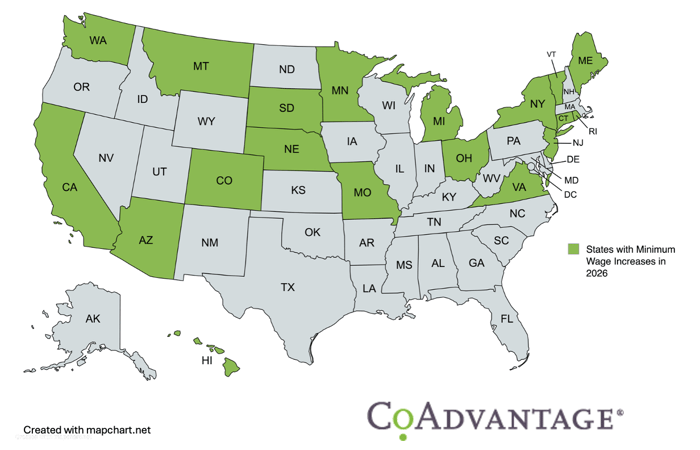
According to the National Employment Law Project (NELP), 88 jurisdictions will raise their minimum wage floors by the end of 2026, including 22 states and 66 cities and counties. Seventy-nine of those jurisdictions will reach or exceed $15 per hour, and 57 will reach or exceed $17 per hour for some or all employers.
The sheer range is significant. The federal minimum wage will remain unchanged at $7.25 per hour, but Seattle, for example, will rise to $21.30 per hour (and $17.13 per hour in the rest of Washington state). California will go up to $16.90 per hour statewide, with some cities rising to as much as $20.25 per hour.
These minimum wage increases alone will require many employers to review pay structures, adjust timekeeping systems, and revisit overtime calculations.
Overtime and Exempt Salary Thresholds
Salary thresholds and overtime eligibility are also under closer scrutiny at the state level. At the federal level, the Biden Administration had previously attempted to implement a new minimum salary rule through the U.S. Department of Labor. Federal courts subsequently blocked those changes, and the Trump Administration has seemingly ended efforts to restore the rule.
In the absence of changes from the federal government, however, states have stepped in. Several states are broadening eligibility, increasing benefit durations, or introducing new employer contribution requirements. These changes directly affect HR compliance, payroll deductions, and employee communications, particularly for employers operating across state lines.
Non-Compete Agreements
Non-compete agreements also remain a moving target. While a proposed federal ban was abandoned in 2025, many states have again stepped in with their own restrictions or outright bans, especially for “lower-wage” workers. Colorado, for example, prohibits non-competes for workers below $130,014.
Depending on where they operate, employers must now tailor restrictive covenant practices by jurisdiction to remain compliant with wage and hour law expectations.
Pay Transparency
Pay transparency laws continue to spread as well, with more states and cities requiring salary ranges in job postings or disclosures during the hiring process. For example, California will require job postings to include a “good faith” pay range.
We wrote about this last year, and it remains true: “Be aware that pay transparency is very, very heavy on the minds of state legislatures,” says Janell Stanton, an HR and employment attorney at Minnesota-based law firm Wagner, Falconer & Judd.
As it is, fewer than half (45%) of U.S. employers are fully meeting existing pay transparency requirements; this is an area where most organizations are already behind. Part of this gap may be due to the complexity of compliance. These rules intersect with HR compliance, compensation strategy, and recordkeeping, but mistakes can lead to penalties and reputational harm.
2. Common Wage and Hour Compliance Pitfalls to Avoid
Perhaps the single biggest challenge here is staying current with the sheer variability of these requirements because regulatory action and enforcement have been shifting away from the federal government and toward state and local governments. “These measures reflect a long-standing pattern: when federal law lags, states act as ‘laboratories of democracy,’ experimenting with stronger protections,” writes legal analysis website TheEduLaw.com.
As a result, many businesses that could have gotten away with just focusing on federal wage and hour law and HR compliance in years past must now contend with piecemeal regulations that change rapidly and vary tremendously between locations.
Outside of that, one of the most common mistakes employers make is employee misclassification, which can impact everything from wages and exempt status to eligibility for paid leave, and more. The key thing to remember: the government (federal or state) doesn’t care if you intend for an employee to be, for example, a contractor rather than a full- or part-time employee. It only cares what you do. Or, as Max Barack of law firm Garfinkel Group, LLC told the National Law Review, “[W]hat you say on paper doesn’t matter as much as what happens in practice.”
Overtime miscalculations are another frequent source of liability; this type of error will probably mount in 2026 as new rules take effect. Common missteps include excluding bonuses or commissions from the regular rate of pay, failing to capture all hours worked, or improperly treating salaried non-exempt employees. Each of these mistakes represents a direct violation of wage and hour law and can quickly escalate into costly back pay claims.
3. Supporting HR Compliance Without Overburdening Your Team
For small and mid-sized businesses, keeping pace with all of these changing wage and hour law requirements can overwhelm internal HR resources. Monitoring legislative changes, updating policies, configuring payroll systems, and training managers is a full-time job in itself.
This is where a professional employer organization (PEO) can make a measurable difference. A PEO provides built-in HR compliance expertise, proactively tracking and enforcing new overtime rules, minimum wage increases, and state-specific mandates on the employer’s behalf.
Then, integrated time and payroll systems help ensure accurate calculations and consistent recordkeeping across jurisdictions. Perhaps most importantly, employers gain access to guidance that helps translate complex wage and hour law changes into practical, compliant action without adding administrative burden.
4. An Extra Pay Period in 2026?
As a final note, 2026 may mean an extra biweekly pay period for some employers. Every 11 to 12 years, “employers will find themselves in a calendar year where 14 or more days follow the 26th pay day,” writes HR Dive. “This scenario makes a 27th pay day necessary.”
Affected employers have three basic options.
- Divide the salary by the total days in the year and then multiple by 14 to determine the affected employee’s payment schedule.
- Maintain the normal 26-week pay cycle but add an additional 27th check at the end of the year. Just make sure to budget accordingly.
- Divide the total salary by 27. This will result in less compensation per cycle than normal, so it might result in fewer disgruntled employees if/when paired with a pay increase. Then, in 2027, return to the normal divide-by-26 approach.
FAQ: Wage and Hour Law Updates for 2026
What are the most important wage and hour law changes employers should prepare for in 2026?
Manager training is critical because managers are the primary users and interpreters of HR technology. Workforce management tools directly shape how managers schedule work, track time, and lead their teams. Without proper manager training, even well-designed HR technology can create confusion and resistance, and incorrectly used technology will inevitably underperform.
Why is HR compliance harder in 2026 than in previous years?
Minimizing disruption starts with preparation. Organizations should select user-friendly workforce management tools, conduct thorough testing, and train managers early. Change management should be embedded from day one, with clear communication about how HR technology will affect managerial workflows and decision-making.
What are the most common wage and hour law violations employers face?
No. Manager training should be ongoing. As workflows evolve and managers gain experience, additional training helps them use HR technology more effectively. Continuous learning prevents stagnation and supports long-term adoption of workforce management tools.
How can a PEO help with HR compliance and wage and hour law requirements?
A PEO provides integrated HR technology, implementation expertise, and ongoing support. By serving as a trusted partner, a PEO helps organizations train managers effectively, manage change proactively, and ensure workforce management tools deliver lasting value.
Do small businesses really need help managing wage and hour law compliance?
Yes. Small and mid-sized employers are often more vulnerable to wage and hour law enforcement because they lack dedicated compliance staff, and the consequences (including financial penalties, legal costs, unfavorable legal rulings, and reputational problems) can be severe. (For more information, read our guide to “What happens when employers violate labor laws?”) Proactive HR compliance support can prevent costly mistakes before they occur.
One of the best ways to deal with rapidly shifting, endlessly confusing compliance regulations is to work with a Professional Employer Organizations (PEO), whose experts will stay on top of everything for you. CoAdvantage, one of the nation’s largest PEOs, helps small to mid-sized companies with every aspect of HR administration, from payroll to compliance and risk management. Learn more about our time and labor management services to keep your organization on top of its obligations year after year.
**The information provided on this website is for general informational purposes only and does not constitute legal advice. While we strive to ensure the accuracy and completeness of the information, we make no guarantees about its correctness, completeness, or applicability to your specific circumstances. Laws and regulations are subject to change, and you should consult a qualified legal professional before making any decisions based on the information provided here.