
Quick Summary
Legal risk tied to employment practices is growing, and employers are facing a landscape where routine missteps can escalate into costly claims. Employment practices liability insurance protects organizations from the legal and financial fallout of harassment, discrimination, retaliation, and wrongful termination allegations.
Yet the most effective approach is to prevent these disputes long before they reach the EPLI stage. Strong preventive practices (including annual handbook updates, clear procedures, thorough documentation, proactive investigations, and manager-focused HR training programs) significantly reduce the likelihood of EPLI claims in the first place.
A PEO partner can help even further by providing compliance infrastructure, risk-reducing HR guidance, and access to reliable EPLI coverage that shields employers from escalating legal disputes.
The Growing Use of Employment Practices Liability Insurance (EPLI).
Commercial insurance claims tied to employment practices are continuing to rise. A 2025 study from insurance group QBE found that a supermajority (69%) of HR and legal professionals experienced an employment-related claim in the previous year, and 42% are expecting claims to increase in frequency.
EPLI “is a good way to mitigate risk to a company,” Danna Hewick, SHRM-SCP, a vice president of human resources, told the Society for Human Resource Management (SHRM), “and it’s unfortunate that many small and midsize companies don’t carry it.”
That’s because EPLI coverage helps protect against claims involving harassment, discrimination, retaliation, wrongful termination, and related allegations. This insurance insulates the employer against potentially ruinous penalties, settlements, legal costs, and jury awards.
But in reality, the best EPLI claim is the one that never gets made, and the best risk mitigation is the practice that prevents problems in the first place.
How Risks Related to Employment Practices Are Rapidly Rising
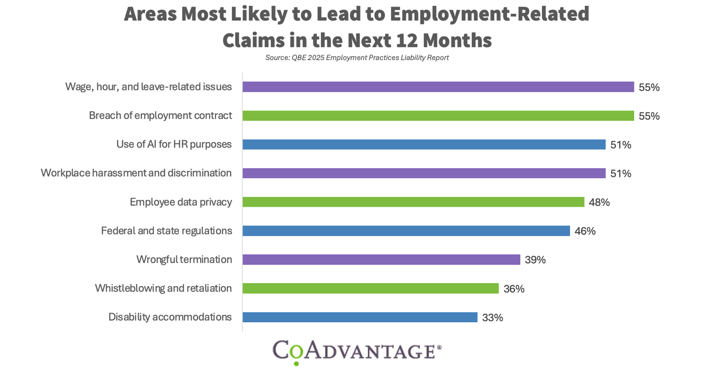
Employment-related liability is expanding quickly, shaped by both persistent problem areas and newer sources of exposure. The QBE report highlights the categories that employers believe are most likely to lead to claims in the next year. At the top of the list: wage, hour, and leave-related issues (55%); breach of employment contract disputes (55%); and use of artificial intelligence for HR purposes (51%).
Yet it’s often preventable HR missteps that lay the groundwork for these issues in the first place.
For example, gaps in documentation, outdated handbooks, incomplete accommodation procedures, inconsistent policy enforcement, and supervisors who lack training all play a role. These missteps either open the door to claims in the areas identified above or increase the likelihood that a dispute will escalate into formal action requiring employment practices liability insurance.
Worse, new risk areas are also emerging faster than many HR teams can adapt. “For instance, AI systems—although intended to provide impartial results—may contribute to discriminatory employment decisions if the algorithms and data sets entered within these systems are biased toward specific groups,” reports insurance agency Dominion Risk Advisors. “Depending on how frequently AI technology is used, biased decisions could occur on a mass scale, presenting multiple avenues for discrimination-based litigation and associated EPL claims.”
One small business, perhaps the first to face an AI-based discrimination in hiring lawsuit on behalf of 200 job applicants, was assessed a six-figure penalty by the EEOC. They will not be the last, however, given that 84% of organizations are using AI tools in some kind of HR capacity, like hiring or evaluation. Regulators and plaintiffs’ attorneys are watching these issues closely.
What Preventive Steps Help Avoid EPLI Claims Before They Arise?
Prevention begins with systemizing the fundamentals. Well-defined procedures, clear expectations, and consistent training give organizations the ability to identify and resolve issues early. A few steps are especially effective at reducing reliance on employment practices liability insurance:
1: Update handbooks and relevant policies annually
This includes anti-harassment language, anti-retaliation guidance, accommodation protocols, pay transparency rules, job posting standards, and clarity around disciplinary processes. These updates should also address emerging risks like AI-based hiring and return-to-office conflicts.
2: Deploy stronger documentation practices
Every performance discussion, complaint, investigation, and disciplinary action should be documented. Thorough, consistent documentation is one of the most effective ways to prevent claims or successfully defend them.
3: Implement routine HR training programs for managers
Frontline supervisors often determine whether an issue becomes a conflict or resolves informally. HR training programs teach managers how to document properly, respond neutrally, escalate issues appropriately, and avoid statements or actions that create liability. This single step significantly reduces the likelihood of needing EPLI coverage.
4: Investigate concerns proactively
Taking complaints seriously, conducting timely investigations, and following documented procedures demonstrate good-faith efforts that protect employers legally.
5: Facilitate stronger cross-department coordination
HR, legal, payroll, workers’ compensation, and leave management teams must share information so that decisions do not contradict one another. “Open communication between departments such as human resources, risk management, leave of absence, workers’ compensation benefits, and legal is critical,” argues HR Dive. “Civil exposure for businesses is often the result of the ‘right hand not talking to the left hand.’”
To be fair, these measures do not replace employment practices liability insurance; insurance exists as a risk mitigation measure against misfortune and sometimes unpreventable problems. But these steps will drastically reduce the likelihood of claims and limit the severity of any disputes that do occur.
How PEOs like CoAdvantage Can Also Help Reduce EPLI Exposure
A PEO can strengthen employers’ protection in two essential ways: prevention and coverage. First, a PEO like CoAdvantage provides employers (especially small to midsize employers) with the compliance infrastructure they often lack internally. These services create consistency and reduce the errors that commonly lead to EPLI coverage claims. This includes:
- Handbook development and annual updates
- Guidance on policy alignment with federal, state, and local regulations
- Manager-focused HR training programs
- Support for handling complaints and investigations
- Documentation guidance and performance management support
- Best practices for emerging risks such as AI, pay transparency, and accommodations
Protection Through EPLI Coverage
Second, most PEOs offer or can recommend employment practices liability insurance. CoAdvantage ensures clients have access to strong EPLI coverage with knowledgeable support. EPLI coverage provides legal defense, settlement protection, and claims management expertise. Combined with preventive HR training programs and updated policies, this creates a more complete shield against employment-related lawsuits.
FAQ: What Employers Should Know About EPLI and Prevention
To gain meaningful protection in a changing risk environment, get help. CoAdvantage, one of the nation’s largest Professional Employer Organizations (PEOs), helps small to mid-sized companies with every aspect of HR administration, benefits, payroll, and compliance. Contact us today to explore our employment practices liability insurance products.
**The information provided on this website is for general informational purposes only and does not constitute legal advice. While we strive to ensure the accuracy and completeness of the information, we make no guarantees about its correctness, completeness, or applicability to your specific circumstances. Laws and regulations are subject to change, and you should consult a qualified legal professional before making any decisions based on the information provided here.